
Why Flooring Is a Rock-Solid Trade Business
Flooring is one of the most stable segments in the construction and remodeling industry. Unlike seasonal trades like landscaping or weather-dependent work like roofing, flooring installation happens year-round — indoors, climate-controlled, and on a consistent schedule.
The U.S. flooring market exceeds $30 billion annually. Every new home, every remodel, every commercial build-out, every rental turnover needs flooring. And unlike some trades where the homeowner might attempt a DIY fix, professional flooring installation is a skill that most homeowners quickly realize they can't replicate — especially for hardwood, tile, and luxury vinyl plank (LVP).
A skilled solo flooring installer can earn $60,000-$100,000+ per year. A flooring contractor with 2-3 crews routinely generates $300,000-$800,000+ in annual revenue. The path from installer to business owner is clear, and the demand supports growth.
Step 1: Choose Your Flooring Specialties
Flooring is a broad trade. Most successful contractors focus on 2-3 types rather than trying to do everything:
- Hardwood (solid and engineered): The premium segment. Requires skill in nail-down, glue-down, and floating installation methods, plus sanding and finishing for refinishing work. Highest margins but steepest learning curve.
- Luxury Vinyl Plank/Tile (LVP/LVT): The fastest-growing segment. Waterproof, durable, and looks like wood or stone at a fraction of the cost. Installation is faster than hardwood or tile, making it a high-volume, good-margin product.
- Ceramic and porcelain tile: Bathrooms, kitchens, entryways, and commercial spaces. Requires precision with layout, cutting, and grouting. Skilled tile setters command premium rates.
- Laminate: Budget-friendly floating floor. Quick installation but lower margins. Good for volume work.
- Carpet: Still a major market for bedrooms, offices, and commercial spaces. Requires a carpet stretcher and seaming skills.
- Epoxy and polished concrete: Growing market for garages, basements, and commercial/industrial spaces.
Recommendation for new contractors: Start with LVP/LVT and hardwood. LVP is in massive demand and installs quickly (revenue per day), while hardwood commands premium pricing and builds your reputation as a craftsman.
Step 2: Legal and Business Setup
- Business registration: Form an LLC. Flooring work involves working in people's homes with expensive materials — liability protection is essential. $50-$500 depending on state.
- Contractor's license: Requirements vary by state. Some states require a flooring-specific or general contractor's license above certain dollar thresholds. California requires a C-15 Flooring and Floor Covering license. Check your state's requirements.
- General liability insurance: $1M minimum. Flooring work has specific risks — scratching existing surfaces, damaging furniture during moves, moisture-related failures. Expect $500-$1,200/year.
- Workers' comp: Required when you hire employees. Flooring rates are moderate — typically 8-15% of payroll.
- Vehicle insurance: Commercial auto for your work van/truck.
Step 3: Essential Tools and Equipment
Starter Kit for Hardwood and LVP ($3,000-$8,000)
- Miter saw: 10" or 12" sliding compound miter — $300-$600. Your most-used tool for cutting planks.
- Table saw: For rip cuts on planks — $300-$500.
- Pneumatic flooring nailer: For nail-down hardwood (Bostitch, Freeman, Primatech) — $300-$800.
- Compressor: For nailers and pneumatic tools — $200-$400.
- Moisture meter: Essential for hardwood — $50-$200. Moisture issues cause the most flooring failures.
- Knee pads: Professional quality (ProKnee or similar) — $50-$100. Your knees are your career.
- Tapping block, pull bar, spacers: For floating floor installation — $30-$50.
- Underlayment tools: Tape, stapler, utility knives — $50-$100.
- Work van: Cargo van or pickup with cap — $15,000-$30,000 used.
Add for Tile Work ($2,000-$5,000)
- Wet tile saw: 10" (DeWalt, MK Diamond) — $400-$1,000.
- Tile cutter (manual): For straight cuts on smaller tile — $100-$200.
- Mixing drill and paddles: For thinset and grout — $100-$200.
- Leveling system: Clips and wedges for flat tile installation — $50-$100 per job.
- Trowels: Multiple sizes for different tile formats — $50-$100.
- Grout float, sponges, buckets: $30-$50.
Total realistic startup: $20,000-$45,000 (including vehicle).
Step 4: Pricing Flooring Jobs
Flooring is typically priced per square foot, which makes estimating straightforward once you know your rates:
2026 Installation Rates (Labor Only)
- Luxury vinyl plank (LVP): $2.00-$4.00/sq ft
- Engineered hardwood (floating): $3.00-$5.00/sq ft
- Solid hardwood (nail-down): $4.00-$7.00/sq ft
- Ceramic/porcelain tile: $5.00-$10.00/sq ft (varies by size and pattern)
- Mosaic tile: $10.00-$20.00/sq ft
- Laminate: $1.50-$3.00/sq ft
- Carpet: $0.50-$1.50/sq ft (plus pad)
- Hardwood refinishing (sand and finish): $3.00-$6.00/sq ft
Common Add-Ons
- Old flooring removal: $1.00-$3.00/sq ft
- Subfloor repair/leveling: $2.00-$5.00/sq ft
- Baseboards/trim installation: $2.00-$5.00/linear foot
- Furniture moving: $100-$300 per room
- Transitions and thresholds: $20-$50 each
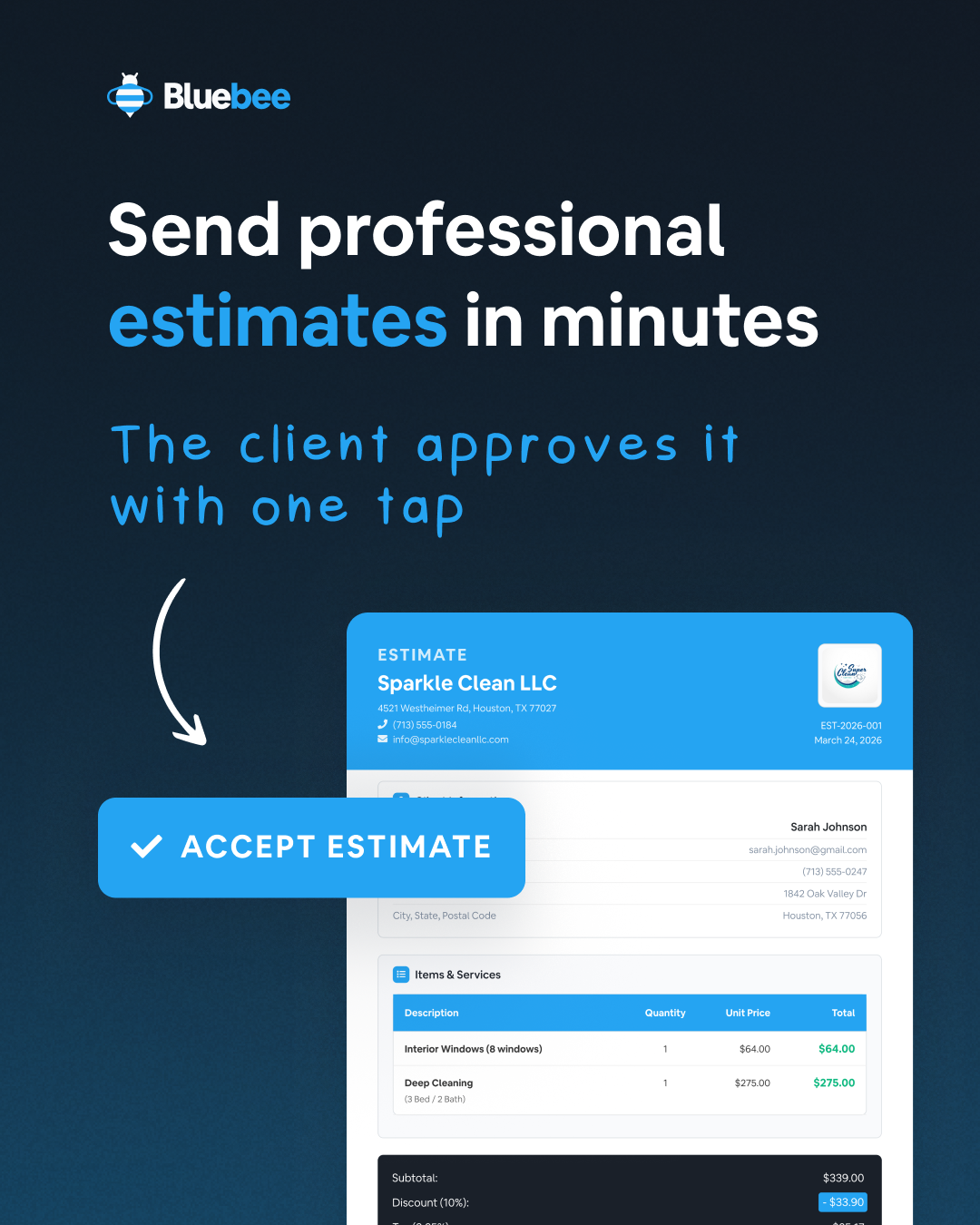
Flooring estimates need to account for square footage, material type, removal, subfloor prep, transitions, and trim. BlueBee App lets you save all your flooring services by type — LVP per sq ft, tile per sq ft, removal, trim — and build itemized estimates on your phone right at the client walkthrough. Send it before you leave. When approved, convert to invoice and collect deposit by card. Download free on the App Store.
Step 5: Finding Clients
- Builder and remodeler partnerships: The #1 revenue source for most flooring contractors. General contractors, kitchen/bath remodelers, and home builders need flooring installed on every project. One relationship with a busy remodeler can keep you booked for months.
- Flooring retail stores: Many flooring showrooms (Floor & Decor, local dealers) refer installation to independent contractors. They sell the material, you install it. Steady volume with no marketing cost.
- Google Business Profile: Homeowners searching "flooring installer near me" or "hardwood floor installation" are high-intent buyers. Complete your profile with before/after photos.
- Real estate flippers: House flippers need fast, quality flooring on every project. They're repeat clients who value speed and reliability over the lowest price.
- Property managers: Apartment turnovers, commercial spaces, and rental properties need regular flooring replacement.
- Home Depot / Lowe's subcontractor programs: Big box stores subcontract installation. Volume is high but margins are lower — good for staying busy but not as a primary revenue source.
Step 6: Build Systems to Scale
- Measurement protocol: Measure every room precisely, note existing flooring type, subfloor condition, door swing clearances, and transition locations. Photograph everything.
- Material calculator: Always add 10% waste factor for standard installations and 15% for diagonal or complex patterns.
- Digital estimates and invoicing: Every job gets a professional estimate with material, labor, removal, and prep itemized separately. BlueBee App makes this simple — create, send, and convert to invoice from your phone. Start free at $9.99/month unlimited.
- Quality control checklist: Before leaving every job: check for gaps, squeaks, levelness, proper expansion gaps, clean grout lines, and transitions properly secured. Walk the entire floor with the client.
- Warranty card: Leave a printed warranty card with every installation. Industry standard: 1-2 years on workmanship, plus the manufacturer's material warranty.

The Bottom Line
Flooring is a stable, year-round trade with strong demand at every price point — from budget laminate rentals to high-end hardwood custom homes. The startup costs are moderate, the skills are learnable, and the client pipeline is deep (builders, remodelers, retail stores, direct homeowners). Focus on 2-3 flooring types, price for profit, build relationships with builders and remodelers, and present yourself professionally with branded estimates. The flooring business rewards consistency, quality, and reliability — deliver those and the work will never stop coming.