
Stop Guessing, Start Calculating
Ask ten landscapers how they price their services and you'll hear some version of: "I just kind of know what to charge." That might work when you're mowing five lawns a week, but it will bankrupt you when you're running a real operation with crews, equipment payments, insurance, and overhead.
The landscaping businesses making real money — $200K, $500K, $1M+ in annual revenue — aren't winging their pricing. They know their cost per man-hour down to the penny, they price every job for a target margin, and they present their estimates in a way that builds trust and closes deals.
This guide gives you the framework to do the same, whether you're a solo operator or running multiple crews.
Know Your Cost Per Man-Hour
This is the single most important number in your landscaping business. Everything else flows from it.
How to Calculate It
Add up every monthly expense in your business:
- Equipment payments and maintenance
- Fuel ($400-$800/month for most operations)
- Insurance (general liability + auto + workers' comp)
- Vehicle payments and maintenance
- Marketing and advertising
- Phone, software, office expenses
- Your salary (what you need to live on, not what's left over)
- Employee wages and payroll taxes (if applicable)
- Supplies, blades, trimmer line, oil, etc.
Divide that total by the number of billable hours worked per month (not total hours — subtract drive time, admin time, and rain days). That gives you your cost per man-hour.
For most solo operators: $30-$45/hour in costs. For crews with employees: $40-$65/hour in costs per person. Add 30-50% on top for profit margin, and you have your billing rate.
Pricing by Service Type
Weekly Lawn Maintenance
The bread and butter. Price by the property, not by the hour — this rewards efficiency.
- Small residential (under 5,000 sq ft): $35-$50/visit
- Medium residential (5,000-10,000 sq ft): $50-$75/visit
- Large residential (10,000-20,000 sq ft): $75-$120/visit
- Commercial properties: Varies widely — measure and price individually
These ranges include mowing, edging, trimming, and blowing. Adjust based on your local market, the complexity of the property (obstacles, hills, gates), and the drive time to get there.
Pro tip: Route density matters more than price per lawn. Five $50 lawns clustered in one neighborhood are more profitable than five $70 lawns spread across town because you eliminate drive time between them.
Mulching
$65-$85 per cubic yard installed (your cost is typically $25-$40/yard for the material).
A typical residential mulching job uses 3-8 cubic yards. Price includes delivery, bed preparation, and installation. This is one of the highest-margin services in landscaping — a $400 mulching job might take 2 hours and cost you $120 in materials.
Spring and Fall Cleanups
Price by the property based on estimated time:
- Spring cleanup (bed clearing, debris removal, first edge of season): $200-$500+
- Fall cleanup (leaf removal, bed prep for winter): $250-$600+
Cleanups are great revenue because they happen during shoulder seasons when your mowing schedule is lighter, filling gaps in your calendar.
Hedge and Shrub Trimming
$50-$80 per man-hour or flat rate per property. Quote based on the number and size of shrubs. A property with 15-20 shrubs that takes a two-person crew 2 hours should be priced at $250-$400.
Landscape Installation
For design/build projects (new plantings, patios, retaining walls, outdoor living spaces), use this formula:
Materials cost + 50-100% markup + labor at your hourly rate + equipment rental if needed
A $5,000 materials job with a 75% markup ($3,750) plus 40 man-hours at $55/hour ($2,200) comes to $10,950. Landscape installation margins of 40-55% are industry standard.
How to Present Estimates That Win
Your estimate is your first impression. A lot number scribbled on a napkin tells the client you're not serious. A branded, itemized proposal tells them you're a professional worth the investment.
What Every Estimate Should Include
- Your company name, logo, and contact information
- Client's name and property address
- Detailed scope of work (what you're doing, not just a price)
- Itemized pricing (so the client sees value, not just a total)
- Timeline (when you'll start and finish)
- Payment terms (when payment is due, accepted methods)
- Warranty or guarantee (even a simple "satisfaction guaranteed" builds trust)
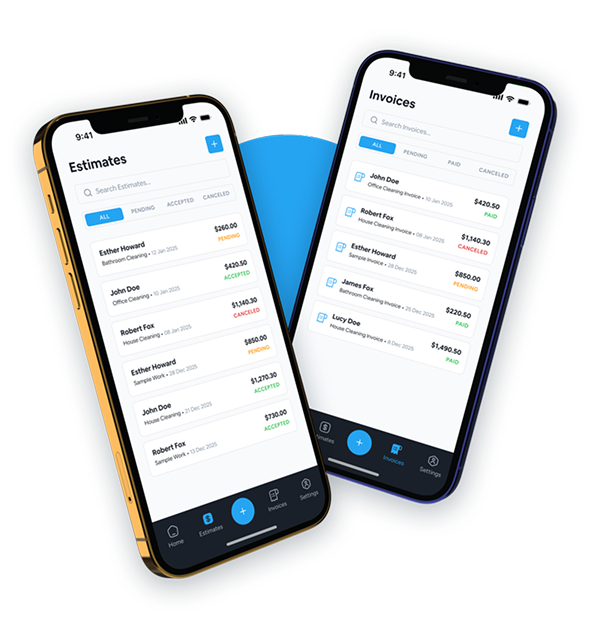
BlueBee App makes creating professional estimates effortless. Build your service library once with your standard landscaping services and pricing, then generate branded estimates on-site in under two minutes. The client gets a polished PDF they can approve with a single tap. When the job is done, convert it to an invoice and collect payment by card — all from your phone. No office needed, no paper shuffling, no chasing checks. The bilingual English/Spanish support is a real advantage in diverse markets. Start free, or go unlimited with the $9.99/month Business plan. Try it on the App Store.
Good-Better-Best Pricing
For larger projects (landscape installations, hardscaping, seasonal packages), present three options:
- Good: Basic scope — the minimum the client asked for
- Better: Recommended scope — what you'd suggest as a professional (this is what most clients pick)
- Best: Premium scope — the dream version with upgraded materials and added features
This psychology works because it anchors the client against the highest price, making the middle option feel reasonable. Without options, clients only have two choices: yes or no. With three options, they're choosing which yes.
Handling Price Objections
When a client says "that's more than I expected" or "another company quoted less":
- Don't panic or discount immediately. Your price is your price.
- Ask what the other quote includes. Often it's a bare-bones scope with no cleanup, no warranty, and no insurance.
- Explain your value: "Our price includes [full cleanup, proper bed prep, premium mulch, one-year plant warranty, licensed and insured work]. We find that clients who've been burned by the cheapest bid end up spending more to have the job done right the second time."
- If they still want cheaper, let them go. Not every client is your client. The ones who choose value over price are the ones who pay on time, leave great reviews, and refer their neighbors.
Seasonal Pricing Strategy
Smart landscaping businesses don't just price per job — they price per season to smooth out revenue:
- Annual contracts: Total all services (mowing, cleanups, mulching, trimming) for the year. Divide by 12. Bill monthly. The client gets predictable costs, you get predictable revenue.
- Off-season services: Snow plowing, holiday lighting, hardscape projects. These fill the winter gap and keep revenue flowing year-round.
- Price increases: Raise prices 3-5% every year. Your costs go up annually — fuel, insurance, supplies, labor. Your prices should too. Communicate increases professionally: "Due to rising costs of materials and fuel, our rates will increase by 4% starting next season."
The Bottom Line
Pricing your landscaping services isn't about being the cheapest in town. It's about charging enough to deliver excellent work, pay yourself and your team fairly, invest in your equipment, and still have profit left over to grow. Know your numbers, present your estimates professionally, give clients options, and don't apologize for pricing that reflects the value of your work. The clients you want are the ones who choose quality and reliability over the lowest bid — and those clients are willing to pay for a professional who knows what they're worth.