
Your Quote Is Your Sales Pitch
Most plumbers think the job starts when they pick up the wrench. But the real sale happens before that — when the client looks at your estimate and decides whether you're the one they trust with their home.
Think about it from the homeowner's perspective. They have a leaking pipe, a clogged main line, or a water heater that's on its last legs. They call three plumbers. All three show up, look at the problem, and give a price. What makes one plumber win over the other two?
It's rarely the lowest price. It's the one who makes the client feel most confident that the job will be done right, at a fair price, with no surprises. And that confidence comes from how you present your estimate.
The Anatomy of a Winning Plumbing Quote
1. Start With a Diagnosis, Not a Price
Before you quote a number, explain the problem. "Your main water shut-off valve is corroded and leaking at the stem. This is a common issue in homes built before 2000 with original brass valves." This does two things: it shows you're competent, and it justifies the price you're about to give.
Document the problem with photos when possible. A picture of a corroded valve or a waterlogged fitting is worth a thousand words — and it prevents the "but it didn't look that bad" objection later.
2. Itemize Everything
A single lump-sum number feels arbitrary to clients. Break it down:
- Labor: valve replacement including shut-off, removal, and installation
- Materials: 3/4" brass ball valve, compression fittings, solder and flux
- Testing: pressure test and leak check after installation
- Cleanup: area restored to pre-work condition
- Warranty: 1-year labor warranty on all work performed
When clients can see exactly what they're paying for, price resistance drops dramatically. They're not comparing your $450 to another plumber's $350 — they're comparing the scope, quality, and warranty of each proposal.
3. Offer Options When Appropriate
For larger jobs (water heater replacement, repipes, bathroom remodels), present good-better-best options. For a water heater replacement:
- Good: Standard 40-gallon tank water heater — $1,800
- Better: High-efficiency 50-gallon tank with 12-year warranty — $2,400
- Best: Tankless water heater with unlimited hot water and energy savings — $3,800
Most clients choose the middle option. But without the comparison, they only see one price and start shopping around for a lower one.
4. Brand Your Estimates
A quote with your company logo, contact information, clear terms, and a professional layout beats a text message or handwritten number every single time. This isn't vanity — it's sales psychology. Professional presentation signals professional work.
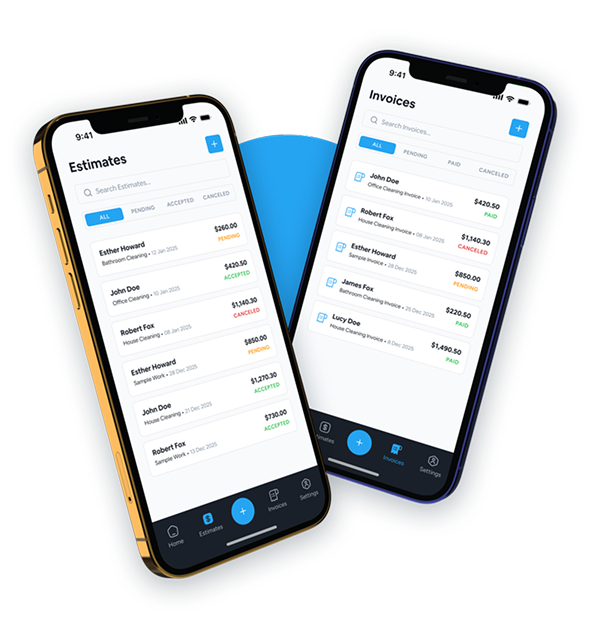
With BlueBee App, you can build your plumbing service library once (faucet repair, drain cleaning, water heater install, garbage disposal, etc.) and create branded estimates on-site in under two minutes. The client gets a polished PDF with your logo, itemized pricing, and a one-tap approval button. When they say yes, you convert it to an invoice with a single tap. No re-entering data, no delays, no lost paperwork. The free plan gets you started, and the $9.99/month Business plan unlocks unlimited estimates and online payments. Try it on the App Store.
Pricing Strategies That Protect Your Margins
Always Charge a Service Fee
A $49-$99 service/trip charge is standard in the plumbing industry. It covers your drive time, vehicle costs, and the expertise you bring just by diagnosing the problem. Apply it toward the repair cost if they hire you — this incentivizes the client to go with you and makes the service fee feel like a deposit, not a penalty.
Build in a Material Markup
Marking up materials 25-50% over your cost isn't gouging — it's standard business practice. You're sourcing the right parts, carrying inventory in your truck, and guaranteeing they're installed correctly. That convenience and expertise has value. Don't apologize for it.
Know When to Walk Away
Not every job is worth taking. If a client is haggling on a fair price, demanding free estimates for complex diagnostic work, or showing signs of being difficult to work with, it's okay to politely decline. Your time and expertise have value, and one bad client can cost you more in stress and callbacks than the job was worth.
How to Handle Price Objections
When a client says "That seems high" or "The other plumber quoted less," don't panic and don't immediately discount. Try this:
- Acknowledge: "I understand. Plumbing work is a significant investment."
- Differentiate: "Our price includes [specific items the competitor probably didn't mention]: a pressure test after the repair, a one-year labor warranty, and licensed/insured work with a pulled permit."
- Ask: "Does the other estimate include the same scope of work, warranty, and permit?" (It usually doesn't.)
The goal isn't to talk them into an overpriced job. It's to make sure they're comparing apples to apples. When they see the full picture, your price almost always makes more sense.
Follow-Up Is Where Jobs Are Won
Here's a stat that should change how you run your business: 48% of service businesses never follow up on an estimate. Almost half. That means if you simply text or call the next day with "Hi [Name], just following up on the estimate I sent yesterday. Any questions I can answer?" — you're already ahead of half your competition.
Set a simple system: send the estimate, follow up in 24 hours, follow up again in 3 days if no response. Three touches, then move on. It takes five minutes total and can increase your close rate by 20-30%.
The Bottom Line
Winning plumbing jobs isn't about being the cheapest — it's about being the most professional, the most transparent, and the easiest to say yes to. Diagnose clearly, quote thoroughly, present professionally, follow up consistently, and price with confidence. The clients who choose on value over price are the ones who pay on time, leave great reviews, and refer their neighbors. Those are the clients you want to build your business on.