

The Pricing Problem Every Cleaner Faces
Ask ten cleaning business owners how they set their prices and you'll get ten different answers. Some charge by the hour, some by the square foot, and some just "eyeball it" based on experience. The reality is that inconsistent pricing is one of the top reasons cleaning businesses struggle with profitability.
The goal isn't just to pick a number that sounds right — it's to develop a system that ensures you're covering your costs, paying yourself fairly, and remaining competitive in your market.
Method 1: Square Footage Pricing
This is the most common method for residential cleaning and the easiest to standardize. You set a rate per square foot and multiply by the home's size.
Typical Rates
- Standard cleaning: $0.05 – $0.15 per sq ft
- Deep cleaning: $0.15 – $0.30 per sq ft
- Move-in/out cleaning: $0.20 – $0.35 per sq ft
For example, a standard cleaning of a 2,000 sq ft home at $0.10/sq ft would be $200. Adjust based on your local market — rates vary significantly between cities.
Pros and Cons
Square footage pricing is transparent and easy for clients to understand. However, it doesn't account for the condition of the home, the number of bathrooms, or whether pets are present. A 2,000 sq ft home with four bathrooms and three dogs takes significantly longer than a 2,000 sq ft home with two bathrooms and no pets.
Method 2: Room-Based Pricing
Instead of measuring square footage, you set a price for each room type:
- Bedroom: $20 – $35
- Bathroom: $25 – $45
- Kitchen: $35 – $60
- Living room: $25 – $40
- Laundry room: $15 – $25
This method naturally accounts for the complexity of each space. Bathrooms and kitchens take more time than bedrooms, and your pricing reflects that.
Method 3: Hourly Rate + Time Estimate
Calculate your required hourly rate (including all costs and profit), then estimate how long the job will take:
Your hourly rate should cover:
- Labor cost (your time or employee wages)
- Supplies and equipment depreciation
- Vehicle and fuel costs
- Insurance and taxes
- Overhead (phone, software, marketing)
- Your profit margin (typically 20-40%)
For most markets, solo cleaners need to earn $40-$75 per hour to run a sustainable business after all expenses. If you're charging $25/hour, you're almost certainly losing money once you account for everything.
Method 4: Flat Rate Packages
Many successful cleaning businesses offer tiered packages — for example:
- Essential Clean: Floors, surfaces, bathrooms, kitchen — $150
- Complete Clean: Essential + bedrooms, dusting, appliance exteriors — $220
- Premium Clean: Complete + inside oven, fridge, windows, baseboards — $320
Packages simplify the decision for clients and make upselling natural. Most clients choose the middle option, which should be your most profitable tier.
Accounting for Variables
Whichever base method you use, adjust for these factors:
- Condition: First-time or heavily soiled homes should be 30-50% more than maintenance cleanings
- Pets: Add $15-$30 for pet hair and dander
- Frequency: Recurring clients (weekly/biweekly) get 10-15% less than one-time cleanings — the reduced price is justified by guaranteed income
- Travel time: Factor in drive time, especially for clients far from your usual service area
Using Technology to Price Faster
Calculating prices on the spot during a walkthrough can be stressful, especially when you're new. This is where technology helps tremendously.
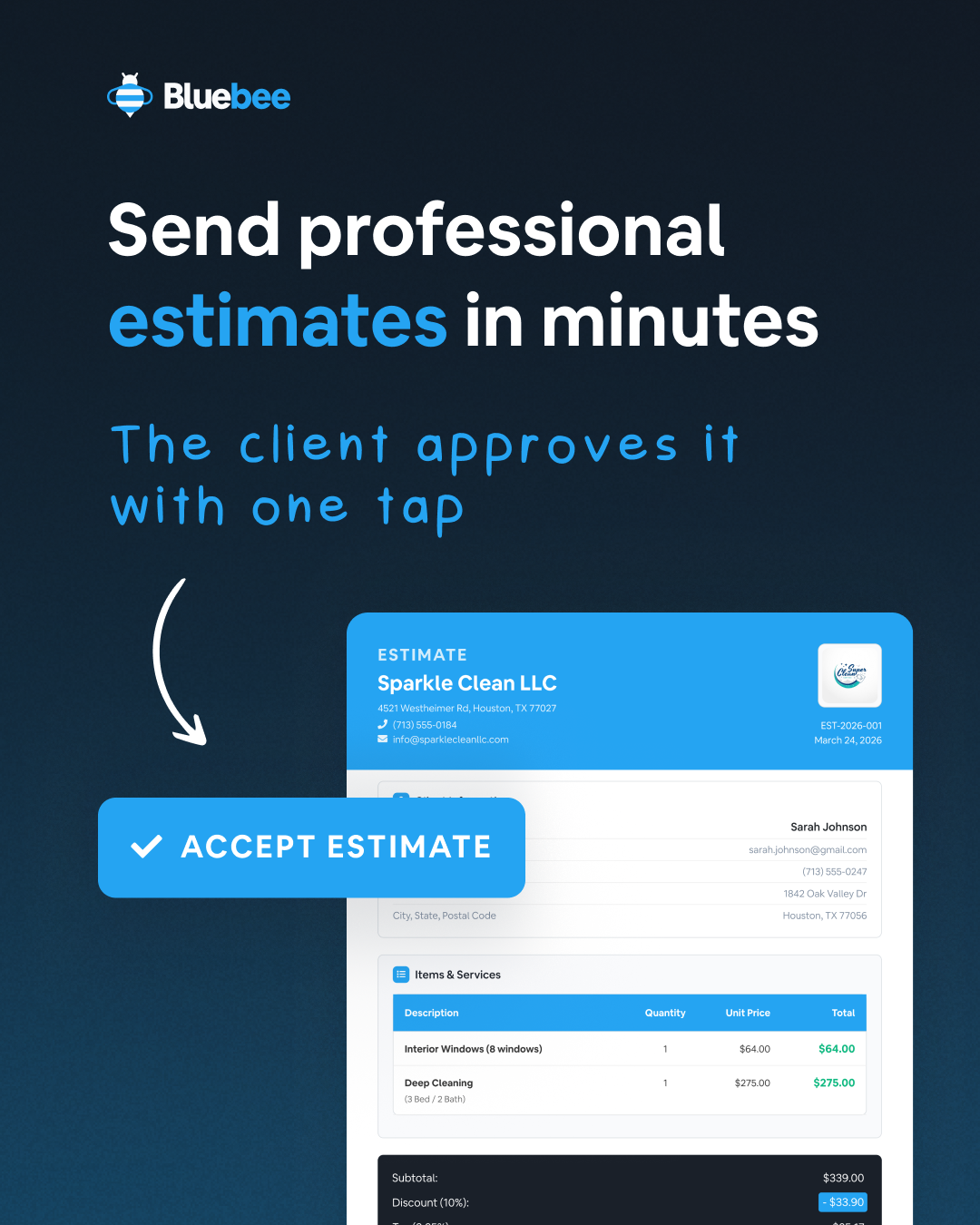
BlueBee App includes a cleaning-specific pricing calculator that helps you build accurate estimates based on your services and rates. You set up your service library once — each service with its price — and then just select the applicable services during a walkthrough. The app generates a professional estimate automatically, which you can send to the client on the spot via SMS or email.
Instead of doing mental math and potentially undercharging, you have a consistent system that ensures every job is priced correctly. Try it free on the App Store with up to 3 estimates per month.
Common Pricing Mistakes to Avoid
- Pricing based on what you'd pay, not what the service is worth. Your perception of value as the service provider is different from the client's.
- Not raising prices annually. Supply costs, fuel, and insurance go up every year. A 3-5% annual increase is standard and expected.
- Undercharging to win every job. You don't want every client — you want profitable clients. If you're winning 90% of your quotes, your prices are too low.
- Forgetting to factor in travel time and admin work. For every hour of cleaning, you probably spend 15-20 minutes on travel, communication, and bookkeeping.
Finding Your Sweet Spot
The right price is one where you can comfortably pay all expenses, pay yourself a fair wage, and still have profit left for growth. If you're booked solid with no breathing room, it's time to raise prices. If you're struggling to fill your schedule, either your prices or your marketing needs adjustment — and it's not always the prices.
Track your acceptance rate on estimates. A healthy rate is around 60-70%. Higher than that means you could charge more. Lower means you might need to adjust your pricing or improve how you communicate value to prospects.